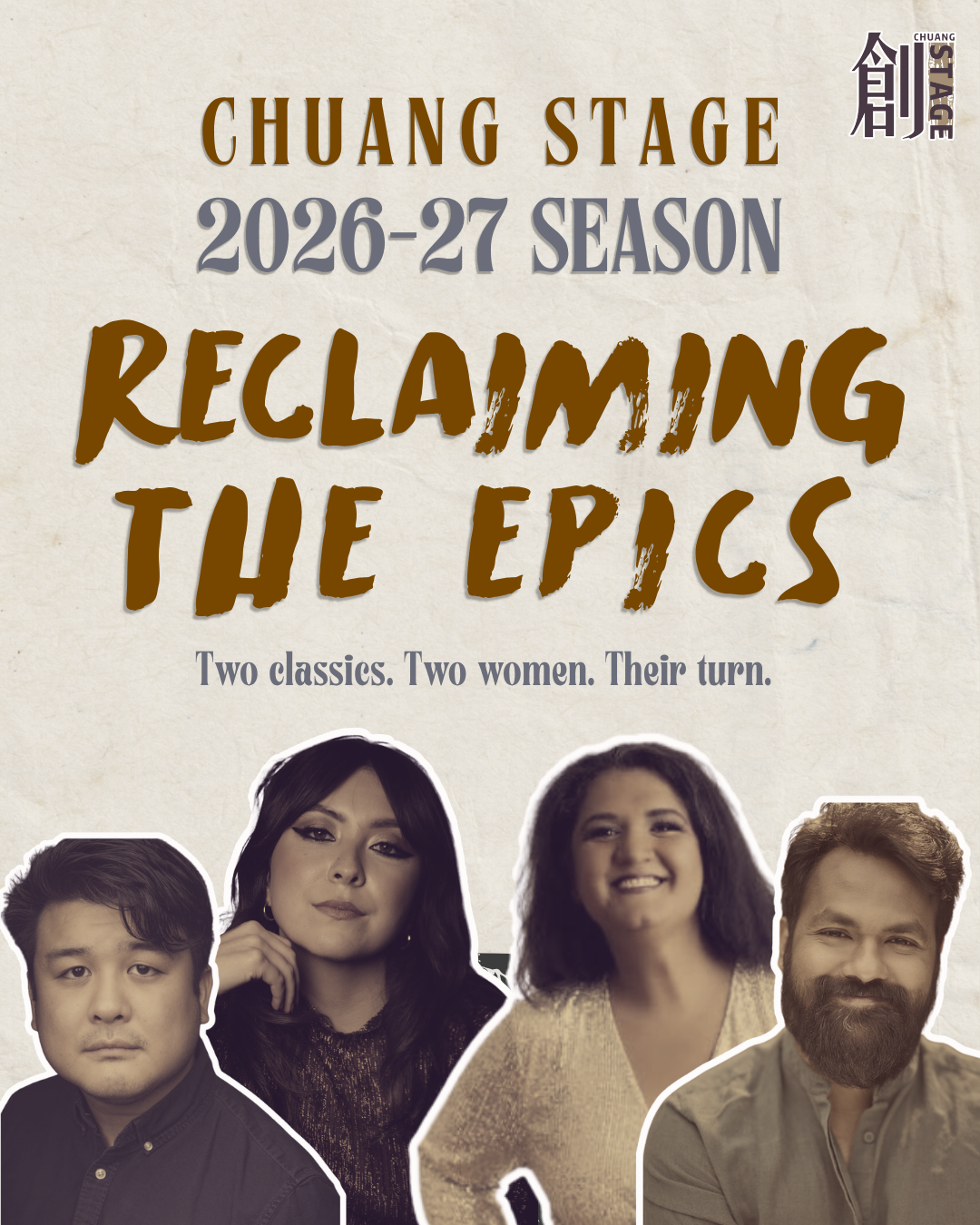
BOSTON, MA—[August 7, 2026]—CHUANG Stage, Boston's Asian American theatre company, today announced its 2026–27 season, Reclaiming the Epics: two productions that take two of the most familiar stories ever told—the Ramayana and King Lear—and hand them to the women at their center. Across the season, CHUANG asks a single question: who gets to author the ending?
Both plays arrive, poignantly, as tributes. The season opens with The Sitayana (or "How to Make an Exit") by the acclaimed playwright Lavina Jadhwani (1983–2025), a Ramayana retelling devised through the eyes of the women at its heart. The season closes with Laowang, a play written for and originated by the legendary actor Wai Ching Ho (1943–2026). Laowang is coming to Boston from Alex Lin (a Forbes 30 Under 30 honoree) following the play's world premiere at Primary Stages.
"There's a particular joy in taking a story you were raised on and turning it over in your hands," said Alison Yueming Qu, CHUANG Stage's Founder & Executive Director. "The classics handed us these towering — and often deeply patriarchal — structures, and adaptation lets us make a deep cut into them, ask who they were built to serve, and build a new world for those the original never made room for. It's how we ask questions about the cultures that shaped us and, in the same breath, make those epic stories our own. To begin with my icon Lavina Jadhwani's version of Sita, devised by a team of desi women, and celebrate with my dear friend Alex Lin's fearless, badass grandmothers — this is the season that Boston and American theatre needed."
Both productions will be staged at the Boston Center for the Arts, where CHUANG is a Launchpad Extension resident company—an ongoing partnership that follows the company's completion of the BCA's three-year Launchpad Residency. As a resident, CHUANG will present both shows in the BCA's Black Box and Plaza theatres, offered through the company's signature Pay-As-You-Are from $0 model to keep the work accessible across the community.
As with every CHUANG season, the shows are only half the evening. Each performance is paired with the company's signature community engagement—lobby activations and something happening every night, from live music and dance to food, craft-making, and artist talks. The theatre becomes a gathering place before and after the curtain, turning a night out into an invitation to linger, connect, and celebrate. It's CHUANG's belief that the work on stage and the community around it are one and the same.
THE SITAYANA (or "How to Make an Exit")
By Lavina Jadhwani · Directed by Tushar Mathew
Boston Center for the Arts, Black Box Theatre
October 14 – 31, 2026 · Press Opening October 16 (PRESS COMPS RSVP HERE)
Drawing from one of the greatest epics ever told, acclaimed playwright Lavina Jadhwani (1983–2025) boldly reimagines the Ramayana through the eyes of Sita—the princess, the queen, the wife, the mother, and this time, the author of her own story. Part Sanskrit epic, part coming-of-age story, and ultimately a break-up play, The Sitayana is a vibrant, witty exploration of love, duty, liberation, and the courage to know when—and how—to make an exit. With movement devised by the ensemble, the production holds that Sita was never one woman: she is all of us.
LAOWANG
Written by Alex Lin · Directed by Michael Hisamoto
New England Premiere
Boston Center for the Arts, Plaza Theatre
April 14 – May 8, 2027 · Press Opening April 16 (PRESS COMPS RSVP HERE)
When a high-rise developer threatens to buy out A-Poh's successful Chinatown restaurant, the martyr-complex matriarch gathers her three precious grandchildren from all corners of the country to plan their next mode of attack. There's just one problem: A-Poh's memory is rapidly fading. What follows is a chaotic journey through reality, myth, and magic as A-Poh travels between now and the great beyond in a last-ditch effort to preserve what's left of her family, her legacy, and her sanity.
A caustic and imaginative spin on King Lear, Laowang explores the changing face of America's Chinatowns and the fight to preserve a fading cultural memory. The production is dedicated to the legacy of Wai Ching Ho (1943–2026).